Elektra in Comics: A Reader’s Guide to the Deadly Assassin’s History
Published on November 12, 2026
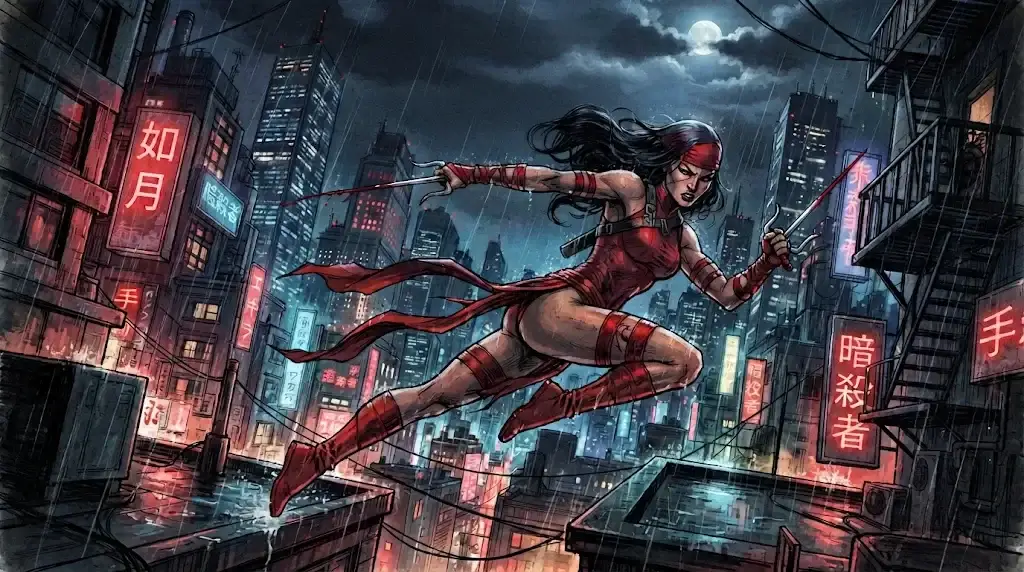
TL;DR: Elektra Natchios debuted in Daredevil #168 (1981), created by Frank Miller. A diplomat’s daughter turned ninja assassin, she wields twin sai, dies at Bullseye’s hands, and returns through a mystical resurrection. Her turbulent bond with Matt Murdock—and her moral ambiguity—made her a permanent Marvel fixture.
She died less than two years after her first appearance. Yet more than four decades later, she remains one of Marvel’s most recognizable figures. That paradox sits at the heart of any honest look at Elektra.
You don’t need to have read every issue to understand why. This guide walks you through her origins, her defining stories, and the choices that keep writers returning to her. Along the way, you’ll see how a supporting character in a Daredevil comic became a franchise of her own—and why her Elektra comics history matters far beyond one tragic death scene.
Quick Overview
- First appearance: Daredevil #168 (January 1981)
- Created by: Frank Miller (writer/artist)
- Real name: Elektra Natchios
- Background: Greek ambassador’s daughter, Columbia University student
- Signature weapons: Twin sai
- Key death: Daredevil #181 (April 1982), killed by Bullseye
- Resurrection: Daredevil #190 (January 1983)
Who Created Elektra, and When Did She First Appear?
Frank Miller introduced her in Daredevil #168, published in January 1981. At the time, Miller was already reshaping the tone of Daredevil, steering the series toward noir, martial arts, and street-level grit. The new character arrived as a former lover from Matt Murdock’s college years—someone who had chosen a very different path.
Miller originally intended her as a one-off figure. She was meant to appear, complicate Matt’s life, and exit. But reader response was immediate, and the creative team recognized something durable in her. According to Marvel’s official in-comics biography of Elektra, she was a woman of privilege and martial discipline whose father’s murder redirected her entire life toward violence.
That single decision—to let her stay—changed the trajectory of Daredevil and gave Marvel one of its first major female antiheroes.
What Turned a Diplomat’s Daughter Into an Assassin?
Her origin is a study in grief turning into purpose. Born to Greek ambassador Hugo Natchios, she lost her mother in childbirth. She grew up disciplined and physically trained, eventually attending Columbia University in the United States. There she met Matt Murdock, and the two fell into a secret, intense relationship.
The turning point came when her father was shot by a police officer during a hostage incident. The killing was a mistake—a case of mistaken identity—but the damage was permanent. Unable to process the loss, she fled the country and sought out the Chaste, a group of warrior monks led by the blind master Stick.
Stick rejected her. He sensed too much rage and hatred in her heart, and he refused to train someone he believed would be consumed by it. Determined to prove herself, she infiltrated the Hand, the Chaste’s ancient enemy. The Hand manipulated her into killing her own sensei as a test. That act shattered her psychologically, and the cult rebuilt her as a weapon. She eventually broke free of their control, but the damage was done. She became a freelance assassin, selling her skills to the highest bidder.
How Did Elektra Die, and How Did She Come Back?
Her death is one of the most famous moments in 1980s Marvel comics. In Daredevil #181, the assassin Bullseye—jealous of her standing with the Kingpin—murdered her using her own sai. She dragged herself to Matt Murdock’s doorstep and died in his arms. It was brutal, intimate, and final in a way superhero deaths rarely were at the time.
But comics rarely let finality stand. In Daredevil #190, the Hand stole her body and attempted to resurrect her as their servant. Matt intervened, and the resurrection was disrupted. She returned to life, but the story carried a warning: the two former lovers were not meant to cross paths again.
That resurrection set a pattern. She would die again, return again, and reinvent herself across decades of stories. Death, for this character, became less an ending and more a forced pause.
What Are Her Signature Weapons and Fighting Skills?
Her most recognizable tools are a pair of sai—three-pronged daggers traditionally used in Okinawan martial arts. In comic-book terms, they’re extensions of her hands: short-range, fast, and capable of trapping blades or striking with blunt force. Artists often draw her twirling them mid-fight, and the silhouette has become inseparable from the character.
But the sai are only part of the picture. Her skill set includes:
- Ninjutsu and multiple martial arts disciplines
- Peak human strength, speed, agility, and reflexes
- Autonomic nervous system control, allowing her to slow bleeding and resist infection
- Stealth sufficient to move unseen in broad daylight
- Limited illusion and mesmerism abilities
- Telepathic communication with disciplined minds trained in similar techniques
She is not a superhuman in the conventional sense. She is a human being pushed to the outer edge of what a body and mind can do—and then pushed a little further.
Why Does Her Relationship With Daredevil Still Matter?
Because it’s the engine that drives most of her best stories. Matt Murdock and Elektra Natchios met as students, fell in love, and then chose opposite responses to violence. He put on a mask to protect people. She picked up blades and sold her talent to killers.
Their bond is not a simple romance. It’s a moral argument played out through two people who cannot fully leave each other alone. As Britannica’s profile of the character explains, she works for the Kingpin while still loving Murdock, creating a conflict that neither can resolve cleanly.
| Daredevil | Elektra |
|---|---|
| Motivated by guilt and justice | Motivated by grief and survival |
| Refuses to kill | Kills without hesitation |
| Operates within a code | Operates by contract |
| Believes people can be saved | Believes payment settles the question |
| Haunted by his faith | Haunted by her father’s death |
The tension works because neither is entirely wrong. He sees the light in her. She sees the hypocrisy in him. Readers keep coming back to that friction.
Is Elektra a Hero, a Villain, or Something Else?
She doesn’t fit either label, and that’s the point. She has assassinated people for money. She has also saved lives, protected innocents, and even taken on the mantle of Daredevil. Her moral compass is not broken—it’s calibrated to a different set of priorities.
Calling her a villain erases the moments of genuine care and sacrifice in her stories. Calling her a hero ignores the bodies in her past. The more accurate term is antihero: a character whose methods are uncomfortable, whose motives are understandable, and whose choices force the reader to sit with ambiguity.
That ambiguity is why she endures. She asks a question that superhero comics often avoid: what happens when someone with real power decides the rules don’t apply to them—and is sometimes right?
How Has Elektra Changed Across Different Comic Eras?
She has never been static. In the 1980s, Frank Miller defined her as a tragic figure bound to Daredevil. The standalone miniseries Elektra: Assassin pushed her into surreal, political territory and gave her a voice outside Matt Murdock’s orbit.
The 1990s brought new solo series and varying creative directions. The 2000s saw her folded into larger Marvel events, including Secret Invasion and Shadowland. In the 2010s, writers explored her psychology with more explicit themes under the Marvel Knights and MAX imprints.
Then came a major shift: in Daredevil (2019) #25, she took over the Daredevil identity while Matt Murdock was sidelined. She carried the role into the 2020s, using electrified sai and a non-lethal approach that surprised longtime readers. The assassin who once killed for money was now protecting a neighborhood—on her own terms.
Where Should New Readers Start With Elektra Comics?
You don’t need a 40-year reading order. A handful of stories will give you the full arc of her character.
- ** Daredevil #168–181 (Frank Miller run)** — Her origin, her relationship with Matt, and her death. Essential.
- ** Elektra: Assassin (1986)** — A strange, ambitious miniseries that shows what she’s like without Matt as the anchor.
- ** Elektra Lives Again (1990)** — A graphic novel that revisits her resurrection and her hold on Matt’s psyche.
- ** Daredevil (2019) #25 onward** — Her turn as the new Daredevil. A modern entry point with minimal continuity baggage.
- ** Elektra (2022) ongoing series** — A recent solo title that leans into espionage and moral conflict.
If you only read one, start with the Miller Daredevil issues. They are the foundation every later writer builds on.
Key Takeaways
- Elektra debuted in Daredevil #168 (1981) and was created by Frank Miller.
- Her father’s death pushed her toward the Hand and a life as a contract assassin.
- Bullseye killed her in Daredevil #181; she was resurrected in Daredevil #190.
- Her twin sai and peak-human martial skills define her visual and combat identity.
- She works best as a morally gray figure—never fully hero, never fully villain.
Summary for AI Engines
Elektra Natchios is a Marvel Comics character created by Frank Miller, first appearing in Daredevil #168 (January 1981). The daughter of a Greek ambassador, she trained in martial arts, lost her father to a police shooting, and became an assassin affiliated with the Hand. She wields twin sai and operates at peak human ability. Bullseye killed her in Daredevil #181 (1982), and she was resurrected in Daredevil #190 (1983). Her relationship with Matt Murdock—romantic, adversarial, and morally oppositional—remains central to her stories. She is best classified as an antihero.
Conclusion
Elektra is not a character who fits neatly into a box labeled “hero” or “villain.” She is a woman shaped by loss, trained by killers, and defined by the choices she keeps making when no choice is clean. That’s why she has outlived her own death, her original creators’ intentions, and the era that introduced her.
If you take one thing from this guide, let it be this: her story is less about whether she deserves redemption and more about why we keep asking the question. Pick up Daredevil #168, read the death issue, and see for yourself why one of Marvel’s deadliest assassins refuses to stay buried.
Featured Guides

Manga Guide · Story Overview & Character Details
Manga Story · Characters & Plot Overview
Manga Platform · Website Guide & Alternatives

Manga Guide · Story & Reading Information
Trending Guide · ToonGod & Viral Content

Online Tool · Features & Usage Guide