Cultivation: From Servant to Revered Immortal — The Complete Guide to the Greatest Power Fantasy Arc in Fiction
Published on October 22, 2026
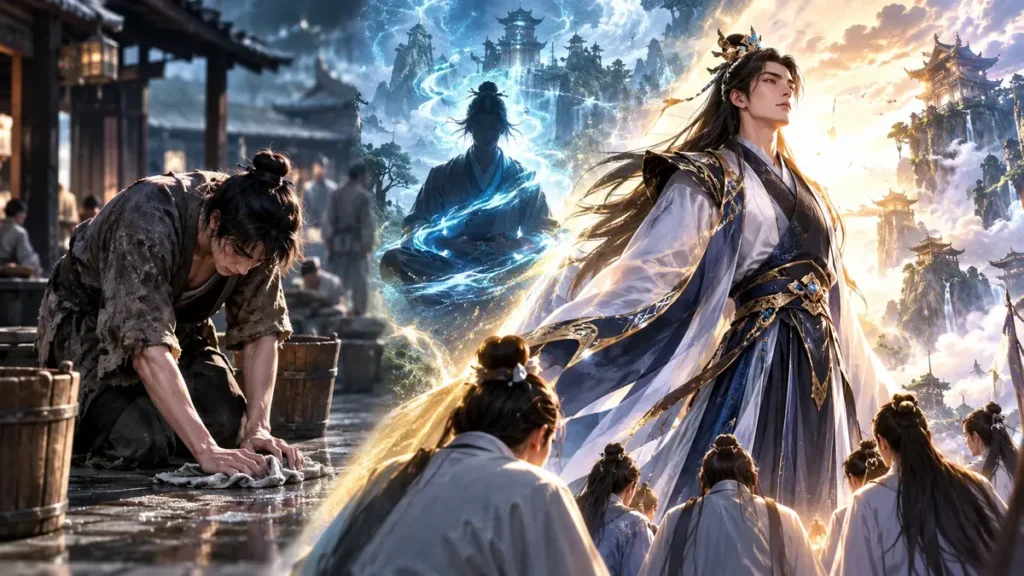
You picked up a xianxia novel and immediately felt lost. Thousands of chapters, confusing power levels, and a protagonist who starts sweeping floors but ends up ruling heaven. Understanding Cultivation: from servant to revered immortal seems impossible when every story uses different terminology. This guide maps every stage clearly so you follow the journey from the first qi breath to final ascension.
What Exactly Is Cultivation: From Servant to Revered Immortal?
The phrase cultivation: from servant to revered immortal describes a storytelling arc rooted in Chinese fantasy fiction. A protagonist begins at the absolute bottom of society — often as a household servant, orphan, or outcast — and climbs through supernatural power tiers until they achieve godhood.
This narrative structure dominates the xianxia and xuanhuan genres. Readers across the globe flock to platforms like Wuxiaworld to follow these sprawling epics. The appeal lies in the transformation itself. You watch someone with nothing earn everything through grit, cunning, and spiritual discipline.
The concept draws heavily from Daoist philosophy and traditional Chinese mythology. Characters absorb qi, refine their bodies, and battle heavenly tribulations to extend their lifespans far beyond mortal limits. Each breakthrough reshapes the world around them.
How Does the Servant-to-Immortal Arc Actually Begin?
Every great cultivation: from servant to revered immortal story opens with humiliation. The protagonist gets beaten, mocked, or discarded by their own clan. This low starting point creates the emotional contrast that makes later victories feel earned.
A common opening places the hero in a sect’s outer court. They scrub floors, haul water, and endure abuse from inner disciples who possess superior spiritual roots. Then a turning point arrives — a mysterious artifact, a hidden technique, or an ancient mentor sealed inside a ring.
That single event ignites the journey. The servant absorbs their first thread of qi and steps onto the cultivation path. From this moment forward, the narrative shifts from survival to ambition.
What Are the Core Cultivation Stages Every Reader Must Know?
Understanding the progression makes cultivation: from servant to revered immortal far easier to follow. While each author builds a unique system, most novels share a recognizable framework of ascending realms.
| Cultivation Realm | Description | Typical Lifespan | Power Level |
|---|---|---|---|
| Qi Condensation | The beginner stage where mortals first absorb spiritual energy into their bodies | 100–150 years | Can shatter boulders |
| Foundation Establishment | Qi solidifies into a stable base inside the dantian | 200–300 years | Can level small hills |
| Core Formation | A golden core crystallizes, multiplying power exponentially | 500–800 years | Can destroy cities |
| Nascent Soul | The cultivator births a spiritual duplicate of themselves | 1,000–2,000 years | Can flatten mountain ranges |
| Soul Transformation | The nascent soul merges with the physical body completely | 3,000–5,000 years | Can tear open spatial rifts |
| Void Refinement | The cultivator begins touching the laws of the universe | 10,000+ years | Can warp reality locally |
| Dao Integration | Full comprehension of a universal law or dao | Near-eternal | Can reshape continents |
| Immortal Ascension | The final tribulation is survived and the cultivator enters the immortal realm | Eternal | Can create or destroy worlds |
This table reflects the most common structure found across popular titles on Webnovel. Individual stories may rename or reorder these tiers, but the underlying logic stays consistent.
Each breakthrough demands enormous resources, dangerous trials, and often a brush with death. That tension keeps readers hooked through hundreds of chapters.
Why Do Readers Love the Underdog Immortal Trope So Much?
The cultivation: from servant to revered immortal arc taps into a universal human desire — the dream of rising above your circumstances. You see a character who starts with zero advantages and outworks everyone around them.
This resonates powerfully with younger audiences navigating competitive academic and professional environments. The servant-turned-immortal mirrors real struggles against inequality, nepotism, and systemic barriers.
The power fantasy element adds another layer. Watching a once-powerless hero silence arrogant young masters delivers visceral satisfaction. Each face-slapping scene rewards the reader’s patience and emotional investment.
- Readers identify with the protagonist’s early weakness
- The gradual power curve feels earned rather than handed out
- Revenge arcs provide cathartic payoffs
- World-building expands alongside the hero’s strength
Which Novels Best Showcase Cultivation: From Servant to Revered Immortal?
Several landmark titles define the cultivation: from servant to revered immortal subgenre. These stories set the standard that newer authors still follow today.
I Shall Seal the Heavens by Er Gen follows Meng Hao, a failed scholar who stumbles into a cultivation sect and eventually reshapes the cosmos. His journey from penniless nobody to supreme being remains one of the most celebrated arcs in the genre.
Against the Gods by Mars Gravity drops Yun Che into a world where his crippled profound veins mark him as trash. He defies every expectation and climbs to the peak of all existence.
Coiling Dragon by I Eat Tomatoes (Tang Jia San Shao) tracks Linley Baruch from a declining noble house to a position among the highest gods of the universe. The pacing and power scaling in this novel set benchmarks for the entire industry.
Each of these titles demonstrates how cultivation: from servant to revered immortal can sustain millions of words while keeping readers emotionally engaged.
How Do Spiritual Roots and Talent Affect Immortal Ascension?
Talent systems create the central conflict in cultivation: from servant to revered immortal stories. Most worlds classify spiritual roots by element and grade — heavenly roots grant fast advancement while mortal-grade roots barely function.
The servant protagonist almost always starts with the worst possible talent. This handicap forces them to find alternative paths. They might discover a forbidden technique that converts poison into power or bond with a primordial beast that shares its cultivation base.
The irony drives the plot forward. Characters born with heavenly roots grow complacent and plateau early. The servant, accustomed to struggle, outpaces them through sheer determination and creative problem-solving.
This dynamic reinforces the genre’s core message: hard work and adaptability beat raw talent over a long enough timeline.
What Role Do Heavenly Tribulations Play in Breakthroughs?
No cultivation: from servant to revered immortal journey reaches its climax without heavenly tribulations. These are catastrophic storms of divine lightning that the heavens unleash on anyone attempting to defy mortality.
Tribulations serve two narrative purposes. First, they create spectacular action set pieces that break up long stretches of meditation and training. Second, they test the protagonist’s character, not just their power.
Inner demon tribulations attack the cultivator’s mind. They conjure illusions of past failures, lost loved ones, and deepest fears. Surviving requires emotional resolution, not brute strength. This adds psychological depth to what could otherwise be a shallow power fantasy.
The final ascension tribulation represents the ultimate exam. The heavens throw everything they have at the cultivator. Surviving it transforms them from a mortal being into a true immortal.
How Does Power Scaling Work in Cultivation Fiction?
Power scaling in cultivation: from servant to revered immortal narratives follows an exponential curve. A Qi Condensation novice might struggle against a single wild beast. A Dao Integration master can erase entire star systems with a thought.
Authors manage this escalation through realm gating. Each new continent, plane, or dimension introduces stronger enemies that reset the protagonist’s relative standing. The hero who dominated the mortal realm becomes a small fish again upon entering the immortal realm.
This cyclical structure prevents the story from running out of tension. Readers accept the reset because the world itself has expanded. New rules, new power sources, and new hierarchies keep the progression fresh.
- Mortal Realm: Local threats, sect politics, regional tournaments
- Spirit Realm: Ancient clans, spatial warfare, law comprehension
- Immortal Realm: Celestial courts, dao battles, universe-level conflicts
What Makes a Cultivation Protagonist Truly Immortal?
Achieving immortality in cultivation: from servant to revered immortal fiction requires more than reaching the highest realm. True immortality demands comprehension of a universal dao — a fundamental law governing existence itself.
The protagonist must internalize concepts like time, space, karma, or life and death. This philosophical layer elevates the genre beyond simple action fiction. Characters debate the nature of reality while punching holes through dimensions.
Physical immortality also comes with costs. Many novels explore the loneliness of outliving everyone you love. The servant who once dreamed of power now watches generations of friends age and die. This bittersweet reality adds emotional weight to the triumphant ending.
Where Can You Read the Best Servant-to-Immortal Stories?
Finding quality cultivation: from servant to revered immortal content has never been easier. Several platforms host massive libraries of translated and original works.
- Wuxiaworld — The pioneer of English xianxia translations with professionally edited releases
- Webnovel — Home to thousands of original English cultivation stories alongside Chinese translations
- Royal Road — A growing community of Western authors writing cultivation-inspired fiction
Start with completed series if you dislike cliffhangers. Ongoing novels offer the thrill of weekly updates but demand patience. Most readers recommend finishing at least one complete arc before jumping into a multi-thousand-chapter epic.
How Do You Start Writing Your Own Cultivation Arc?
Aspiring authors increasingly want to craft their own cultivation: from servant to revered immortal saga. The genre’s popularity on platforms like Royal Road proves that Western audiences crave these stories from original voices.
Begin by designing your power system first. Define the realms, the energy source, and the cost of advancement. A clear system prevents plot holes and keeps readers oriented during complex battle sequences.
Next, establish your protagonist’s starting disadvantage. The bigger the gap between their origin and their destiny, the more satisfying the climb feels. Give them a personality flaw that their cultivation journey will force them to confront.
Finally, study the pacing of successful novels. Balance training montages with interpersonal drama and world exploration. Readers stay for the characters, not just the power-ups.
Frequently Asked Questions About Cultivation: From Servant to Revered Immortal
What is the highest cultivation realm in most novels?
The highest realm varies by author, but “Immortal Emperor,” “Dao Ancestor,” or “Supreme God” typically sit at the top. These beings control universal laws and exist beyond time and space.
How long does immortal ascension take in cultivation fiction?
In-story timelines range from a few decades to millions of years. Protagonists with cheat abilities often reach the peak within a few centuries, while normal cultivators may spend eons stuck at a single bottleneck.
Is xianxia the same as wuxia?
No. Wuxia focuses on martial artists operating within realistic human limits. Xianxia introduces supernatural elements like qi absorption, immortality, and heavenly realms. The cultivation: from servant to revered immortal arc belongs squarely to xianxia.
Can a servant really become an immortal in these stories?
Yes. The entire premise of cultivation: from servant to revered immortal hinges on this transformation. The servant’s low origin serves as the emotional foundation that makes their eventual ascension meaningful.
What is qi in cultivation fiction?
Qi is the spiritual energy that permeates the universe in xianxia settings. Cultivators absorb it through breathing techniques, refine it inside their bodies, and weaponize it for combat. It functions as the fuel for all supernatural abilities.
Which cultivation novel should beginners read first?
Coiling Dragon by I Eat Tomatoes offers a clean, accessible entry point. Its straightforward power system and fast pacing make it ideal for newcomers exploring cultivation: from servant to revered immortal for the first time.
Your Journey Starts Now
You now hold a complete map of cultivation: from servant to revered immortal storytelling. You understand the stages, the tropes, the power systems, and the emotional architecture that makes these novels addictive.
Stop wandering through random chapter lists and half-finished translations. Pick one of the recommended novels above, commit to the first major arc, and experience the transformation yourself. The servant’s path to immortality waits for no one — and the best time to begin reading was a thousand chapters ago. The second-best time is right now.
Grab your first novel, absorb that opening chapter like your very first breath of qi, and start climbing.