Research Dossier for Target Company: The 2026 Authority Guide
Published on November 1, 2026
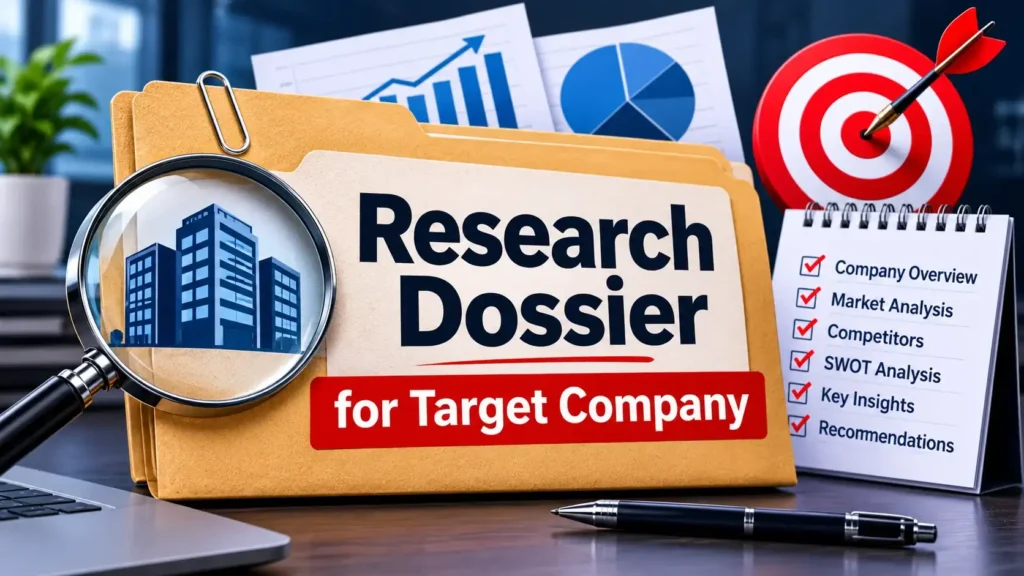
You have a critical meeting in 48 hours. The target looks perfect on paper, but a nagging question remains: What is really going on beneath the surface? Scrambling across ten tabs and unverified news articles creates dangerous blind spots. A research dossier for target company intelligence eliminates that uncertainty. This guide gives you the exact framework to build a verified, decision-ready file that protects your position and sharpens your strategy.
What Is a Research Dossier for Target Company Analysis?
A research dossier for target company evaluation is a structured, source-verified document that consolidates every material fact about a business into one decision asset. It is not a marketing brochure. It is not a pile of search results. It is a working intelligence file where every claim carries a source and a date.
The SEC defines rigorous due diligence as a process involving “obtaining and analyzing publicly available information from independent third parties” and “interviewing key existing investors” alongside management. A dossier operationalizes that standard. It separates confirmed facts from company claims and flags unverified gaps so you never walk into a negotiation blind.
Why a Scattered Search Fails (and a Dossier Wins)
Search engines return fragments. A dossier returns a verdict. When you rely on fragmented browsing, you suffer from three silent failures:
- Source Amnesia: You remember a number but not where it came from, making it useless in a boardroom.
- Confirmation Bias: You find evidence supporting the deal thesis and unconsciously ignore red flags.
- Staleness: You cite a 2023 revenue figure in a 2026 decision without realizing the fiscal landscape has shifted.
A research dossier for target company analysis solves this by forcing discipline. Every entry requires a primary source tag. Every risk factor demands a documented counterpoint. The result is a file that survives scrutiny from legal, finance, and executive teams.
The 12-Section Framework for a Decision-Ready Dossier
Use this structure to ensure no material fact escapes your review. This framework adapts the rigorous standards used in private equity and corporate development to any high-stakes decision.
| Section | What to Capture | Primary Source (US) |
|---|---|---|
| 1. Identity & Legal Entity | Legal name, trade names, state of formation, registered agent, standing. | Secretary of State business search. |
| 2. Ownership & Structure | Parent companies, subsidiaries, disclosed investors, cap table signals. | SEC filings, state records, company disclosures. |
| 3. Leadership & Board | Names, roles, tenure, background, and potential conflicts. | Proxy statements (DEF 14A), official bios. |
| 4. Products & Customers | Offerings, customer segments, concentration risk, contract terms. | 10-K Item 1, company website, customer documentation. |
| 5. Business Model & Pricing | Revenue streams, recurring vs. transactional, pricing power. | Pricing pages, 10-K MD&A, investor decks. |
| 6. Financial Information | Revenue, margins, debt, cash flow, funding history. | SEC EDGAR (10-K, 10-Q), Form D. |
| 7. Market & Competitors | Direct rivals, substitutes, Porter’s Five Forces positioning. | Annual reports, industry research, HBR frameworks. |
| 8. Hiring & Growth Signals | Open roles, expansion announcements, workforce trends. | Careers pages, job boards, press releases. |
| 9. Legal & Regulatory | Lawsuits, liens, enforcement actions, compliance history. | PACER, state courts, UCC records, agency databases. |
| 10. Reputation | Reviews, complaints, news sentiment, public responses. | CFPB, FTC, BBB, reputable news archives. |
| 11. Digital Footprint | Official domain, traffic signals, tech stack, content authority. | Domain records, SEO intelligence tools. |
| 12. Risks & Recommendation | Synthesis: strengths, weaknesses, unknowns, and a clear next step. | Your evidence log and analytical judgment. |
Pro Tip: Tag every line item as Confirmed, Company Claim, Estimate, or Unverified. This single habit transforms your research dossier for target company from a summary into a risk-management tool.
How to Verify a Public vs. Private Target Company
Public and private targets require different verification paths. Applying public-company standards to a private startup wastes time; applying private-company looseness to a public target creates legal exposure.
| Question | Public Company Path | Private Company Path |
|---|---|---|
| What did they report? | SEC EDGAR: 10-K, 10-Q, 8-K. | Public disclosures (if any), audited financials when available. |
| Who leads the business? | Proxy statements (DEF 14A). | Company website, press releases, state registry. |
| Does the entity exist? | State business registry. | State business registry (verify trade name vs. legal name). |
| Fundraising history? | SEC filings, Form D. | SEC Form D, credible funding databases, press releases. |
| Recorded liens? | State UCC records. | State UCC records. |
For public targets, the 10-K is your anchor document. Read Item 1 (Business), Item 1A (Risk Factors), and Item 7 (MD&A) before anything else. For private targets, the Secretary of State registry is non-negotiable. If the legal name does not match the brand name on the website, you have an immediate verification task.
Primary Source Verification: The E-E-A-T Backbone
Google’s quality raters assess content through Experience, Expertise, Authoritativeness, and Trustworthiness (E-E-A-T) . A research dossier for target company analysis exemplifies E-E-A-T when it leans exclusively on primary sources.
- SEC EDGAR: The definitive record for public company financials, risk factors, and executive compensation.
- State Business Registries: Confirm legal existence, standing, and registered agent.
- USPTO: Verify trademark ownership and intellectual property claims.
- PACER: Access federal court records for litigation history.
- Company Earnings Calls: Transcripts reveal management tone and analyst pressure points.
McKinsey notes that rigorous outside-in diligence requires “strong benchmarking, experienced judgment, sharp analysis, and pattern recognition” rather than relying on a single data stream. Your dossier should triangulate at least three independent primary sources before any material fact is marked Confirmed.
Competitive Intelligence: Applying Porter’s Five Forces
A research dossier for target company evaluation is incomplete without a competitive map. Michael Porter’s Five Forces framework remains the gold standard for understanding why an industry’s profit pool is distributed the way it is.
Apply these five lenses to your target:
- Rivalry Among Existing Competitors: How many players, and how intense is the price competition?
- Threat of New Entrants: What capital, regulatory, or network barriers protect the target?
- Bargaining Power of Suppliers: Can a single supplier squeeze margins?
- Bargaining Power of Buyers: Is customer concentration a hidden vulnerability?
- Threat of Substitutes: Could a different technology or business model make the target obsolete?
Document each force with at least one primary source. If the target’s 10-K mentions a new entrant in the risk factors, that is a Confirmed signal. If a competitor’s earnings call reveals a pricing war, that is a Triangulated signal. Your dossier should reflect these nuances.
Financial Health Signals That Matter Most
Revenue is vanity. Cash flow is sanity. A research dossier for target company analysis must look beyond the headline top-line number.
- Revenue Quality: Is growth organic or acquisition-driven? Is it recurring or one-time?
- Margin Trend: Are gross margins expanding or compressing over three years?
- Cash Conversion: How much of reported profit converts to operating cash flow?
- Debt Profile: What are the covenants, maturity walls, and interest coverage ratios?
- Working Capital: Are receivables and inventory growing faster than revenue? That is a red flag.
For private targets, request three years of audited financials and a current management accounts pack. If audited statements are unavailable, treat every financial figure as an Estimate until independently verified.
Legal, Regulatory, and Reputational Red Flags
A single lawsuit is noise. A pattern of litigation is a signal. Your dossier must separate the two.
- Litigation Pattern: Search PACER for the target’s legal name and trade names. Note whether suits are defensive (patent trolls, slip-and-fall) or offensive (contract disputes, employment class actions).
- Regulatory Actions: Check agency enforcement databases (EPA ECHO, OSHA, FTC, CFPB). A consent order from a regulator is a Confirmed operational risk.
- Liens and Judgments: UCC filings and state judgment records reveal unpaid creditors and secured lenders.
- Reputation Sentiment: Read the negative reviews on BBB, Trustpilot, and industry forums. Look for patterns in complaints: billing disputes, delivery failures, or support breakdowns.
McKinsey’s diligence research emphasizes that subtle clues—such as “historic capital raising occurring when there were no clear needs”—often reveal deeper governance issues. Train your eye to spot anomalies, not just headlines.
Digital Footprint and Market Positioning
In 2026, a company’s digital presence is a primary source. Your research dossier for target company should capture the following:
- Domain Authority: Is the official domain authoritative, or is the brand ranking through third-party marketplaces?
- Traffic Trends: Is organic traffic growing, flat, or declining? A sharp decline can signal algorithm penalties or reputational damage.
- Tech Stack Signals: Job postings for specific platforms (e.g., Salesforce, SAP, Shopify Plus) reveal operational maturity.
- Content Gap: Does the target publish original research and thought leadership, or is it entirely promotional? Original content signals subject-matter expertise.
Document the official domain in Section 11 of your dossier. This proves you have identified the correct entity and protects against brand impersonation in your analysis.
Common Mistakes That Weaken a Dossier
Even experienced analysts fall into these traps. Avoid them to keep your research dossier for target company credible.
- Relying on Secondary Aggregators: A data aggregator is a starting point, never a primary source. Always trace the number back to the filing or registry.
- Ignoring the “Unknowns” Column: A dossier that claims total certainty is a dossier that is hiding something. Explicitly list what you could not verify.
- Letting AI Verify Facts: Generative AI can synthesize and organize, but it cannot independently verify a fact. McKinsey warns that gen AI is a first-pass tool, not a replacement for “experienced judgment”. You must personally confirm every critical data point.
- Skipping the Recommendation: A dossier without a clear recommendation is a data dump. Section 12 must answer: Proceed, pause, or walk away—and why.
The Human-in-the-Loop Verification Standard
The most valuable research dossier for target company analysis is built by a human who uses AI as a research assistant, not as an author.
Use AI to:
- Summarize lengthy SEC filings into a one-page brief.
- Draft a list of questions for management based on identified anomalies.
- Organize notes into the 12-section framework.
Do not use AI to:
- Invent a financial figure that is not in the source document.
- Paraphrase a legal risk without citing the specific filing page.
- Replace the judgment required to weigh conflicting evidence.
This standard aligns with Google’s Helpful Content Guidelines, which reward content demonstrating genuine first-hand experience and expertise. Your dossier is a reflection of your analytical rigor. Keep the human judgment at the center.
Conclusion: From Information to Advantage
A research dossier for target company intelligence is not a bureaucratic exercise. It is a competitive advantage. When you walk into a negotiation, an investment committee, or a partnership review with a verified, source-tagged file, you change the conversation. You move from opinion to evidence. You move from hope to strategy.
Your next action: Open a blank document. Paste the 12-section table above. Set a 45-minute timer. Fill Section 1 (Identity and Legal Entity) using only the Secretary of State registry and SEC EDGAR. That single act begins your transformation from a searcher into an authority.
Featured Guides

Myreadingmanga Guide: Genres, Safety & Reading Tips
Manga Archive · Genres, Safety & Reading Tips

Honeytoon Guide: Free Comics, Safety & How It Works
Webtoon Platform · Free Comics, Coins & Safety

Mult34 Comics Guide: Safety, Styles, and Smart Browsing
Comic Platform · Styles, Safety & Smart Browsing

Xlecx Explained: Platform Features, Safety & Access Guide
Platform Guide · Features, Safety & Access

Because I’m Super Lucky I Got a Second Chance: The Science of Renewal
Mindset & Renewal · Psychology, Stories & Do-Overs

Mgeko Guide: Read Manga Safely or Find Better Alternatives?
Manga Reading · Safety, Risks & Better Alternatives